
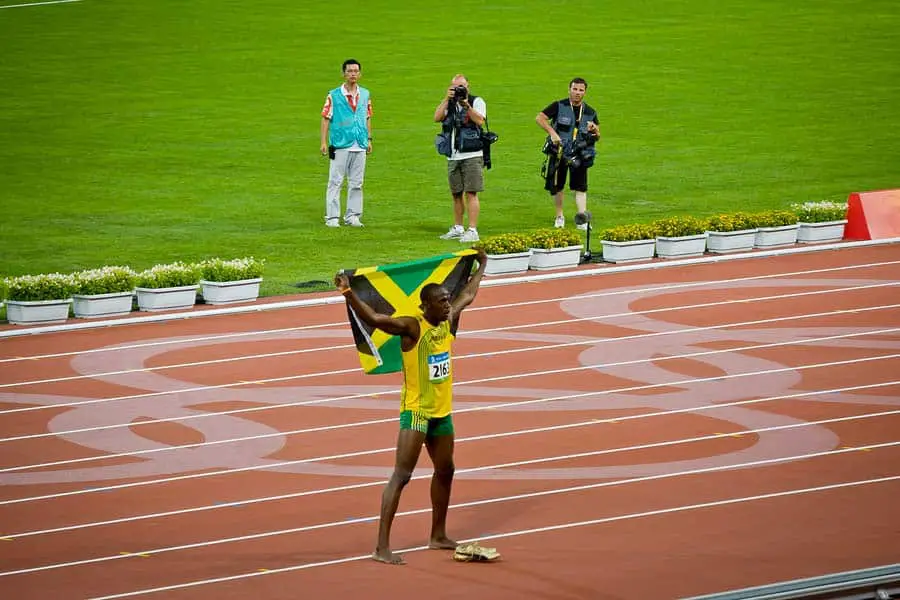
The Jamaican wonder Usain Bolt gave the world another phenomenal show at the Beijing Olympics last night. "Lightning" Bolt lived up to his nickname by finishing the 200-meter final in 19.30 seconds, snatching Michael Johnson's world record of 19.32, set 12 years ago. Michael Johnson's record was spectacular itself, and many thought it would stand a long long time. (The third fastest performance in this event is considerably distant - 19.62 by Tyson Gay.) It's clear that Bolt put everything he had into winning this record, unlike his 100-meter performance.
Usain "Lightning" Bolt, a 21-year-old Jamaican, took the Olympic 100 meter final by storm today in Beijing. After a relatively poor start and easing up in the last 20 meters to pound his chest and gaze about, Bolt crossed the line in just 9.69 seconds with his left shoelaces coming loose. The effort broke his own world record of 9.72s, set earlier this year. You have to wonder how fast this man could run if he really tried.
In races where milliseconds count, runners can't afford any type of disadvantage. Unfortunately for this year's Olympians, the use of an old technology will give a slight advantage to the runners assigned to the inside lanes of the track.
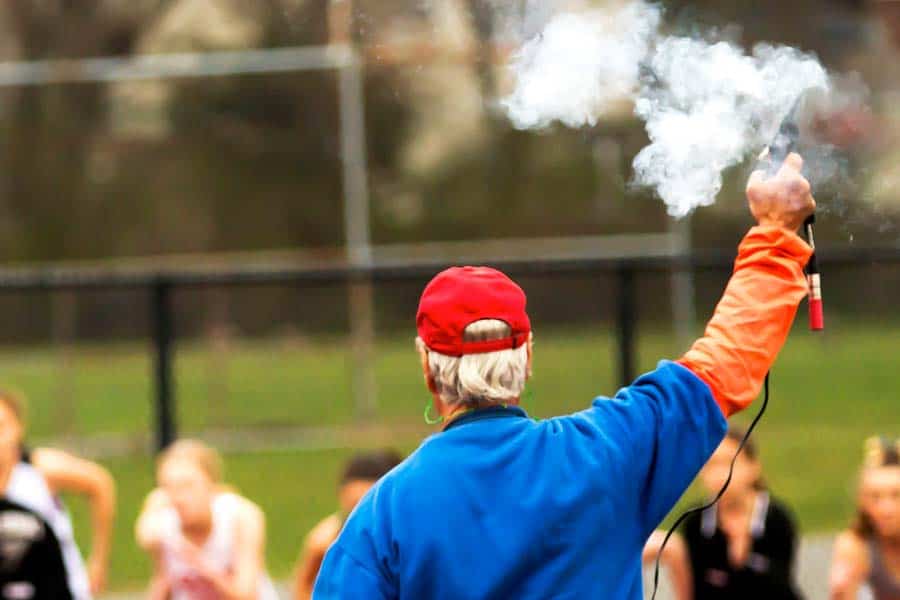
This problem is introduced because "loud guns" are still employed at the Olympics Games. These are starting guns that fire blank cartridges, creating a loud "bang" to alert athletes of the start.
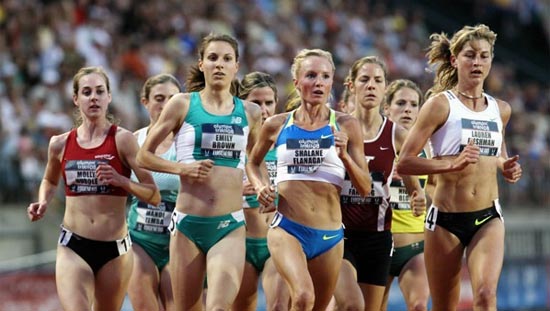
Although sound travels through air very quickly, it does have a finite speed, meaning that the runners closest to the gun will hear the blast first. This becomes especially significant in races such as the 4x100m relay, where the starters are staggered around the first turn of the track. Scientists have calculated that the sound of the gun in such a race will reach the outermost runner 0.150 seconds after it reaches the innermost runner. This is a big deal in sprinting - amounting to a meter or more at the finish line. Furthermore, the sound of the gun is louder when it arrives at the closer runners' ears. Scientists at the University of Alberta have found that a louder signal is more likely to lead to a startle response in runners, lowering their reaction time by up to 0.018 seconds.
Most modern track events now place loudspeakers behind the blocks of each runner. These loudspeakers are designed to all give a tone at precisely the same moment, and the gun that the starting official holds is actually silent, producing no sound of its own. This technique guarantees that each runner will hear the start tone at the same moment as the other runners. Although these loudspeakers are employed at the Olympics, a silent gun is not used, and researchers have found that the runners actually respond to the sound of the gun when both are available.
The effects of this phenomenon were confirmed at the 2004 Athens Olympics. Researchers at the University of Indiana found that the runners in the outside lanes were slower out of the blocks by the amount predicted by the speed of sound.
The problem could reach even further than expected, as a bad start will often affect an athlete's entire race. Runners may tense up and perform worse after a relatively poor start.
The International Association of Athletics Federations says is is aware of this problem and is developing new standards to correct it. Yet, amazingly, it sees no need to make emergency changes before the Beijing Olympics.
Last week at the US Olympic Trials three runners from Oregon seemingly came out of nowhere to sweep the 800m finals. Nick Symmonds wove through an amazingly small gap and won the race with an impressive kick in the final 150 meters. He was followed by 6'5" Andrew Wheating and Christian Smith, who literally dove to the finish line to inch out Khadevis Robinson and Lopez Lomong. Video (race starts at 2:30) and results below.
Due a very disappointing sprain and fall at the U.S Olympic Trials (video below), Tyson Gay did not qualify for the 200 meters in Beijing. Gay is the defending world champion in the 200 and would have been the favorite in Beijing. An MRI has revealed a mild strain in Tyson Gay's left hamstring, and he has been advised to restrict his training for the next two weeks.
Before this incident Tyson Gay qualified for the Olympics by winning the 100-meter finals. He is also expected to participate in the 4x100m relay if he is healthy. At this point, Gay insists that he will be ready in August, saying that he'll "be 100 percent for the 100 and 400 relay".